
Most homeowners start their solar journey with one assumption: panels go on the roof.
But the reality is, the best solar system doesn’t start with the roof, it starts with the property.
Every home is different. The size of your land, the layout of your roof, your long-term energy goals, and even how much sun your property gets throughout the day all play a role in determining the right system. For some homeowners, ground mounted solar panels offer a more flexible and higher-performing solution than they initially expect.
In this guide, we’ll walk through how to determine the right fit for your property, including cost, space requirements, performance, maintenance, permitting, and real-world planning considerations.
Choosing solar isn’t about picking a system, it’s about designing one around your property.
The most effective solar installations consider:
Some homes are ideal for rooftop solar. Others are better suited for a system that can be placed and designed without those limitations.
The key is not forcing a solution but finding the one that fits naturally.
Ground mounted solar panels tend to be the right choice when the property allows for it.
They are especially well-suited for:
There are also important planning considerations that come into play. Septic fields must be avoided when identifying installation areas, and the land itself needs to support both performance and construction.
When those conditions are met, a ground-mounted system can open possibilities that rooftop solar simply cannot.
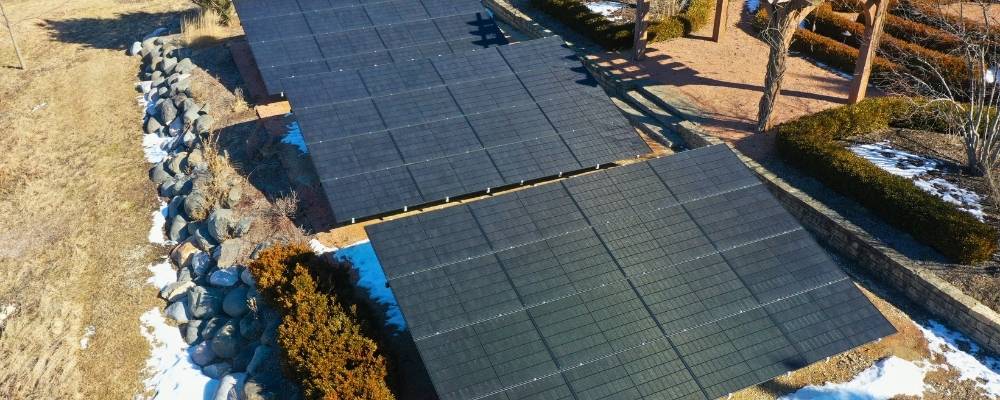
Ground-mounted systems typically come with a slightly higher upfront cost.
That additional investment often includes:
Electrical routing is a key factor. Depending on the property, power is brought back to the home or facility through trenching or directional boring, which adds complexity compared to rooftop systems.
However, the long-term value can be significantly stronger.
Because ground mounted solar panels can usually be positioned due south and installed at the optimal pitch, they often produce more energy over time. That improved production can translate into greater long-term savings and a stronger return on investment.
Solar performance is heavily influenced by how and where panels are installed.
Ground-mounted systems offer more control over:
Another key factor is heat.
Solar panels lose efficiency as they get hotter. Ground-mounted systems typically allow for better airflow behind the panels, helping keep them cooler and reducing voltage loss caused by heat.
Rooftop systems are more limited in this regard due to fixed angles and heat buildup from the roof surface.
Ground-mounted systems require more than just open land, they require the right land.
Key considerations include:
Soil conditions are also an important factor. The type and stability of the soil determine how the system is anchored and whether posts can be driven directly into the ground or require additional structural support.
The goal is to identify a location that works from both a production and construction standpoint.
Not all ground-mounted systems are the same. The right type depends on the property, goals, and budget.
The most common and cost-effective option. Panels are installed at a set angle optimized for the location.
Elevated systems that can be useful for uneven terrain or when additional clearance is needed.
More advanced systems that follow the sun throughout the day, increasing production but adding cost and complexity.
Each option has its place depending on how the system is being used and what the property allows.
One of the biggest advantages of ground-mounted systems is accessibility.
Because the system is installed at ground level:
Ground-mounted solar panels also avoid roof penetrations, reducing structural concerns and simplifying long-term ownership.
Combined with better airflow and reduced heat stress, this can contribute to strong durability over time.
Practical constraints play a major role in determining the right solar setup.
These include:
Routing power from the array back to the home or facility is a key part of the installation process, and the approach will depend on the property layout and site conditions.
A well-designed system accounts for all these factors early, ensuring a smoother installation and long-term performance.
A recent project in Barrington Hills demonstrates what it looks like to design solar around a property rather than forcing a standard solution.
The homeowners wanted to reduce their reliance on the grid while preserving the refined look and feel of their home. Aesthetics, performance, and long-term energy independence were all key priorities.
ilumen Solar designed a fully customized system tailored to the property. The project involved advanced electrical work, complex load balancing, and detailed battery configuration planning.
The system was carefully integrated into the property to balance performance with appearance. Over time, the project evolved to incorporate adjustments around generator integration, while maintaining reliability and safety.
This type of project highlights what is possible when solar is approached with a property-first mindset.
The right solar solution depends on your property, not a default approach.
Consider the following:
Answering these questions can help clarify whether a ground-mounted system is the right fit.

The most effective solar systems are not one size fits all.They are designed around the property, the homeowner’s goals, and long-term energy use. If you are considering solar, the best next step is a custom evaluation that looks at your land, layout, and energy needs to determine the right solution for your property.